
Got your A1C back and aren’t sure what it means? Here’s how to read the number and what to ask your provider next.
The Prediabetes A1C Range
The prediabetes A1C range is 5.7% to 6.4%. Below 5.7% is normal, and 6.5% or above is in the diabetes range.
Here’s how the CDC breaks down the three ranges:
A1C result | Range |
|---|---|
Below 5.7% | Normal |
5.7% to 6.4% | Prediabetes |
6.5% or above | Diabetes |
If your result falls in the middle row, you have plenty of company. The CDC estimates that 115.2 million US adults have prediabetes.
Your number is a good place to start a conversation with your provider. The sections below explain what it measures and what to ask at your next visit.
What Your A1C Measures
Your A1C shows your average blood sugar over about the past 3 months. A single finger stick shows your blood sugar in that moment, while an A1C gives a longer view.
That average doesn’t count every week equally. The past 30 days carry more weight than the weeks before them, so your recent numbers have the biggest effect on your result.
You also don’t need to fast before this test, which makes it easier to fit into your day.
What 5.7, 6.0 and 6.4 Can Tell You
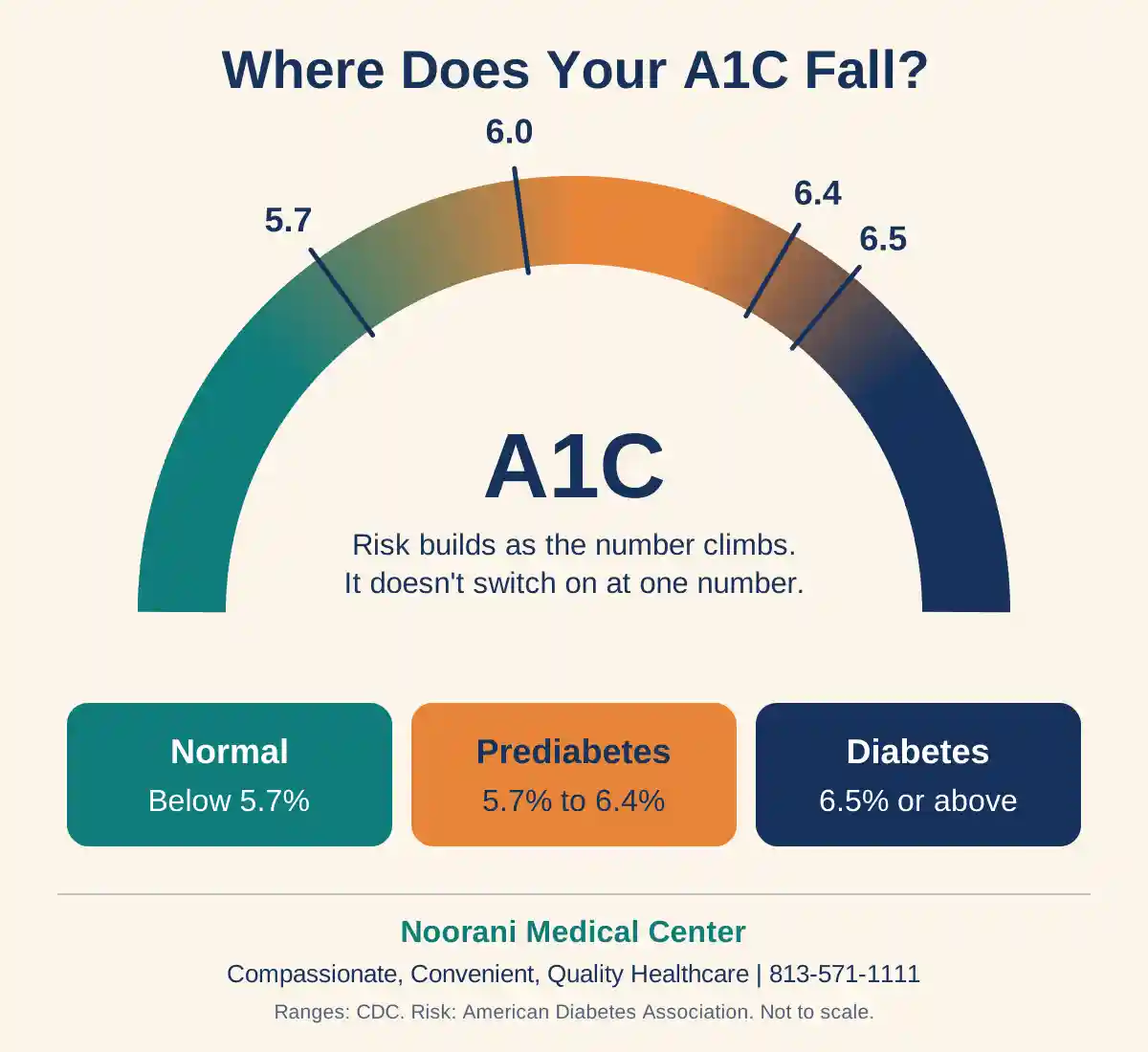
The closer your A1C is to 6.5%, the higher your risk of type 2 diabetes tends to be.
The American Diabetes Association describes that risk as continuous, so it doesn’t switch on at one exact number.
It can also extend below the prediabetes range, and it rises more sharply at the high end.
These examples show where each number falls in the range. They can’t tell you what your result means for your health, because that depends on your full picture.
An A1C of 5.7: This is the lowest number in the prediabetes range. Because risk is continuous, a result here isn’t far from one just below it, even though it falls in a different row of the chart.
An A1C of 6.0: This falls near the middle of the prediabetes range.
An A1C of 6.4: This is the highest number in the prediabetes range, one step below the diabetes range. Risk is greater at this end of the range.
Have questions about your A1C? Our care team is happy to talk it through.
Call 813-571-1111.
Why One Result Isn’t the Whole Story
One A1C result usually isn’t the final word. According to the NIDDK, if you don’t have symptoms, a repeat test on a different day is used to confirm a diagnosis.
So your provider may want a second result before drawing any conclusions.
Some health conditions and life events can also affect an A1C result.
According to the CDC, these include:
- Severe anemia
- Kidney failure
- Liver disease
- Certain blood disorders
- Some medicines
- Blood loss or transfusions
- Early or late pregnancy
If any of these apply to you, let your provider know. It can help them decide how to read your result and whether another test makes sense.
A1C vs. Fasting Blood Sugar
An A1C shows your average over about 3 months, while a fasting blood sugar test shows your level at one point in time after you haven’t eaten. Your provider may use one or both.
Here’s how the two tests compare:
Header | A1C result | Fasting blood sugar |
|---|---|---|
What it shows | Average over about 3 months | Your level at one point in time |
Fasting needed? | No | Yes |
Prediabetes range | 5.7% to 6.4% | 100 to 125 mg/dL |
Your two results may not always tell the same story.
According to the NIDDK, A1C and glucose tests can disagree, so one could fall in the prediabetes range while the other doesn’t.
Since each test looks at a different time frame, your provider can help you understand what the difference means for you.
The fasting range in the table comes from the American Diabetes Association.
Questions to Ask Your Provider
The best next step is a conversation with your provider, and a few good questions can make it more useful.
You might want to write these down before your visit:
- Do I need a repeat test? Ask whether your result should be confirmed, and which test makes the most sense for you.
- How often should I be tested? The American Diabetes Association recommends monitoring at least once a year for people with prediabetes, adjusted to individual risk. Your provider can tell you what schedule fits you.
- Would a prevention program make sense for me? Ask whether a lifestyle program could be a good fit and how to find one.
- What’s my overall risk? Your A1C is one number. Ask how it fits with the rest of your health.
If you’re managing a long-term condition, you can also learn more about our chronic disease treatment in Riverview.
What to Expect at Your Visit
At Noorani Medical Center in Riverview, your care team will go over your lab results with you and answer your questions.
If you need blood work, you have two options.
We can draw your blood in our office and send it to a lab, or you can have it drawn at Quest or Labcorp, and your results will be sent back to us.
New patients are welcome.
Can prediabetes be reversed?
Yes, it can be, especially when it's caught early, according to the CDC, but no one can promise that for a specific person. A CDC-led lifestyle program can lower the risk of type 2 diabetes by 58%, or 71% for people over 60. Its goals include at least 150 minutes of activity a week and, when relevant, losing about 5 to 7% of body weight. Those are program results, not guaranteed outcomes, so ask your provider what makes sense for you.
Does prediabetes mean I have diabetes?
No. Prediabetes means your result is in the 5.7% to 6.4% range, which is below the diabetes range of 6.5% or above. Your provider can explain where your result falls and whether you need another test.
Will I need medication?
Not necessarily. The American Diabetes Association's 2026 guidance continues to put lifestyle and weight loss first for prevention. Medication can also help delay or prevent type 2 diabetes, though it's less effective than lifestyle programs. Whether it's right for you is a decision to make with your provider.
How often should I get my A1C checked?
If you have prediabetes, the American Diabetes Association recommends monitoring at least once a year, adjusted to your individual risk. Your provider can tell you what schedule fits you, and a preventive care visit is one way to stay on top of your testing over time.
How worried should I be?
A prediabetes result is worth acting on, but it's also very common. People can have prediabetes for years without clear symptoms, and the CDC says 8 in 10 adults who have it don't know. Knowing your number gives you the chance to talk through next steps with your provider.